
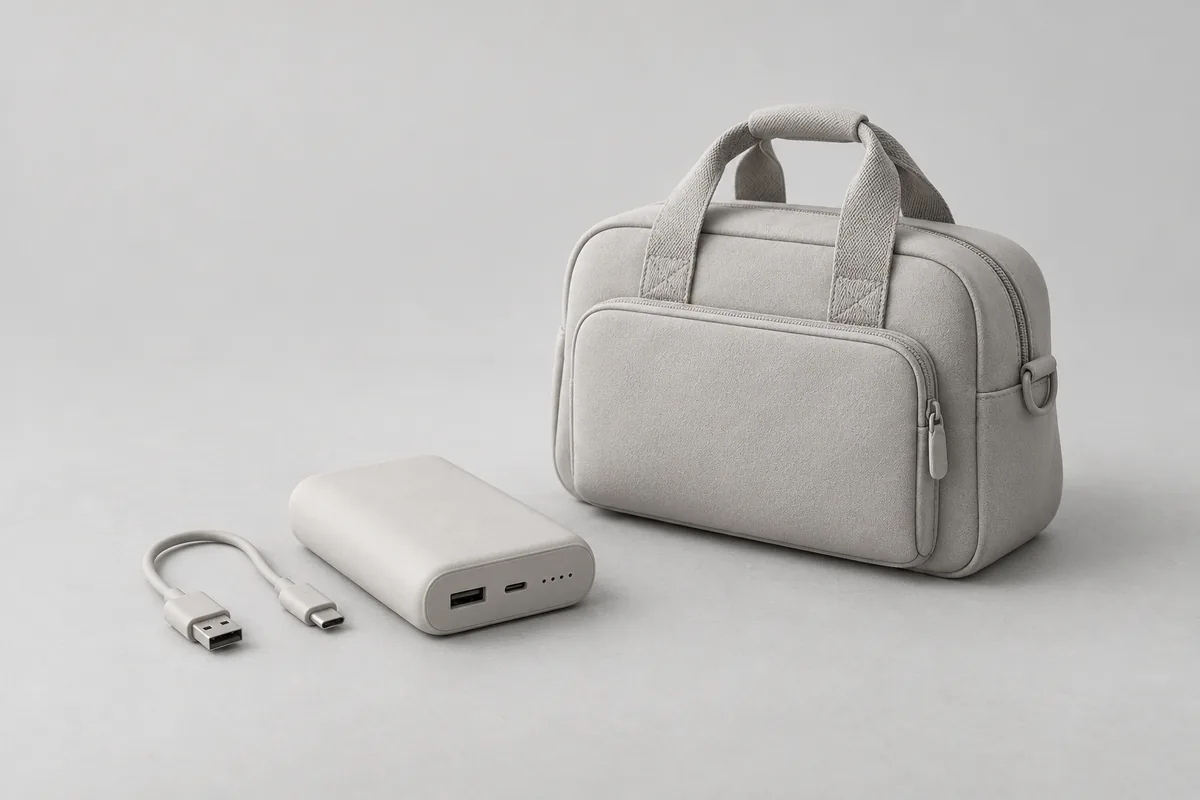
Check the two-unit limit and each unit’s capacity
When taking power banks, count the total carried by one person rather than how many are in each bag. South Korea’s government guidance effective April 20, 2026 limits them to two per person, each at 160Wh or below. New or small units still count toward the total. [1]
Jeju Air’s current Korean-language restricted-items guidance also allows no more than two power banks, with airline approval required for units above 100Wh and up to 160Wh. Units exceeding 160Wh cannot be transported. Check the quantity and approval conditions together rather than assuming that one unit is automatically acceptable. [3]
Replacement batteries used in devices such as cameras are distinct from power banks. Korean Air’s Korean-language guidance sets a combined maximum of two power banks and spare batteries in the above-100Wh-to-160Wh band. If you have separate spare batteries, show their type and capacity when checking the allowance. [2]
Read the Wh label rather than the advertising
Look for the Wh marking in the small print on the product. Watts, or W, describing charging power are not the same as watt-hours, or Wh, describing stored energy. A charger labeled “65W” does not establish that a battery is 65Wh. If you are unsure which figure you read, check the manual or manufacturer’s label.
If Wh is absent but the battery’s capacity and voltage are clearly marked, you can calculate mAh × V ÷ 1000. Korean Air’s official example of 15,000mAh at 3.7V equals 55.5Wh. Apply the calculation only when those are the product’s stated conditions. Do not insert 3.7V for every power bank or confuse battery voltage with output-port voltage. [2]
If worn markings make capacity difficult to verify, send the airline the product photo and model number before departure. Korean Air says batteries whose capacity cannot be confirmed may be restricted. A product with verifiable labeling is easier to explain during check-in than a handwritten replacement sticker. [2]
Protect the terminals and pack each unit separately
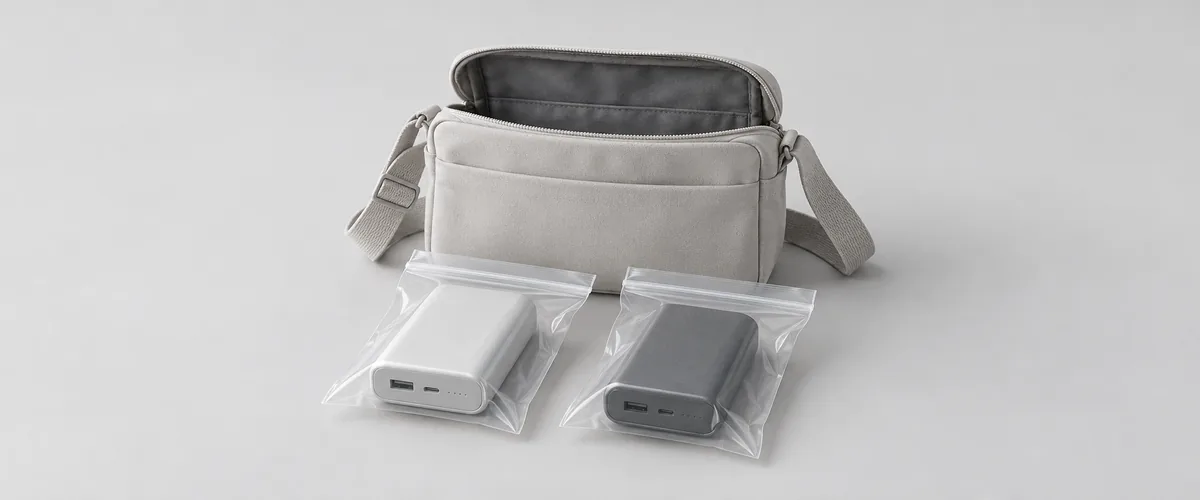
Power banks cannot go in checked baggage, so pack them in your carry-on items. A small pouch with batteries separated from charging cables makes them easier to find if airport staff request a check or you need to repack your bag. Finally, confirm they are not with other chargers inside a suitcase you will check in. [1]
Jeju Air describes short-circuit protection such as individual plastic bags, insulating tape, or terminal caps. Do not leave batteries loose in a pocket with coins, keys, or other metal items. Check that your chosen method protects the terminals properly. If using zip-top bags, pack one battery in each. [3]
Putting a battery in a carry-on bag does not settle onboard storage requirements. Korean Air prohibits storage in the overhead compartment. Follow cabin crew instructions to keep it in an accessible location when seated, and do not take swollen or damaged units. Check the product’s condition as well as terminal protection before departure. [2]
Stop both using and charging power banks onboard
South Korea’s government guidance prohibits both charging another electronic device with a power bank and charging the power bank itself from onboard power. It does not permit one of the two simply because you only connect it to a phone or only charge it from the seat’s USB port. [1]
Disconnect your phone from the power bank before boarding, and save material you need onboard in advance. You can check information needed immediately after arrival, such as mobile tickets, accommodation addresses, and booking confirmations, at the airport. Do not assume every seat has a charging port; check the aircraft and seating information.
Ask separately about batteries for medical equipment. Jeju Air describes exceptions needed for medical purposes such as using a portable oxygen concentrator, or POC, but these do not apply identically to every airline or medical device. Tell the operating airline the device name, battery capacity, and need for use in advance, and check approval and operating conditions. [3]
Check the return and connecting flights too
Acceptance on the outbound flight does not establish the same conditions for the return or a connection. Korean Air says flights departing overseas may be subject to stricter airport or national rules. Check the restricted-items page of the airline actually operating the aircraft as well as the ticket seller’s information. [2]
For example, Jeju Air says power banks exceeding 32,000mAh cannot be transported on its flights departing Thailand. This condition belongs to that airline’s guidance for those departures. Do not extend the same mAh limit to other countries or airlines; check the departure point and operating carrier for your itinerary. [3]
Before closing your bags, check each product’s Wh, the total quantity, any approval requirement, individual packing, and its position in your carry-on luggage. For items needing approval, such as high-capacity units or medical equipment, ask in advance and keep the response instead of raising them for the first time at the airport. This guide uses information checked on October 1, 2026.